Listen to this article
Five days after my stroke, I was scheduled to start an online meditation course.
Months earlier, I had participated in another meditation class and enjoyed it so much that I registered for another.
Lying in a hospital bed at Johns Hopkins Hospital, I was dismayed by my physical situation and wanted any piece of normal life back, so I asked someone to bring me my laptop with the belief that I could join the meditation classes at night.
In hindsight, it’s hard not to laugh at how naïve I was that I thought I could participate in the class from my hospital room. Needless to say, I never did attend those classes from the hospital.
A few months later, I finally attended that meditation course I missed due to my stroke, but most importantly, I realized that having some experience with meditation would prove to be a significant help in my recovery after stroke.
How Meditation Helped Me in Stroke Recovery
The biggest benefit I’ve experienced with meditation in stroke recovery is the ability to slow down when the world feels like it’s moving a million miles per hour.
I’ve often told others that life after stroke can feel like a dream where everyone is going about their business at a normal pace and you’re running as fast as you can, but you’re barely keeping up.
When my mind is racing, bouncing from topic to topic, I’ve often found a simple 5 to 15-minute meditation practice to be incredibly helpful.
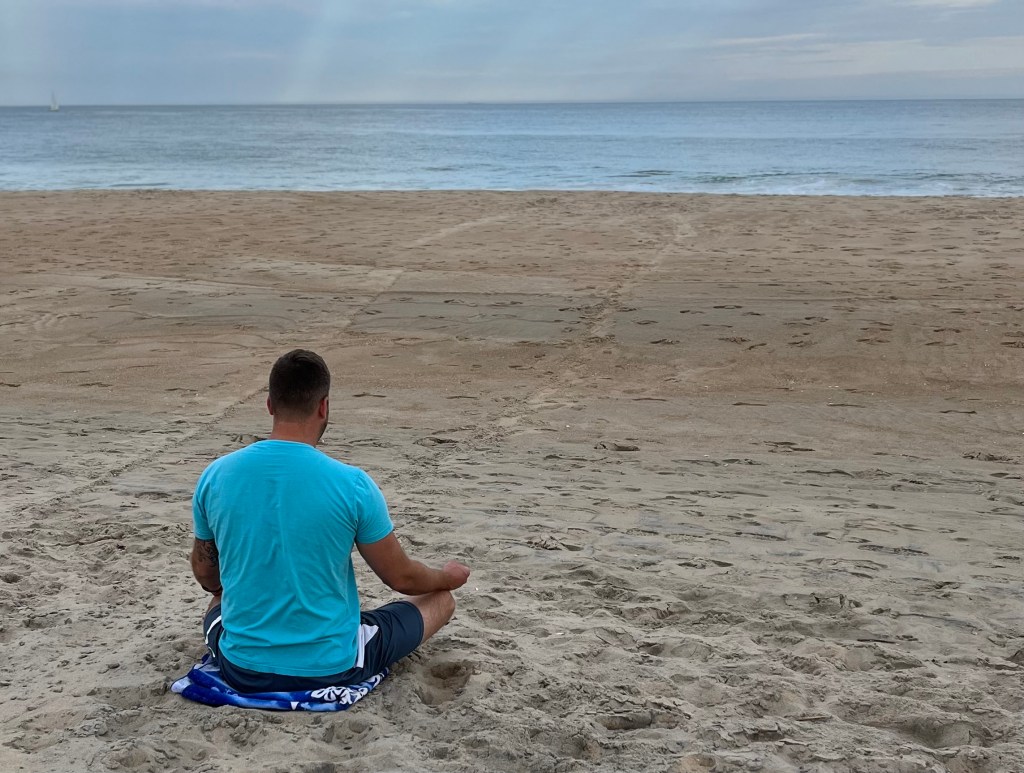
As cliché as it is, my experience has been that the less I move and the more I sit still, the clearer and slower my thought process becomes.
In addition to these short meditation practices to calm a racing mind, I’ve also found Yoga Nidra – a form of meditation – to be incredibly valuable in working through post-stroke fatigue.
How Meditation Can Help Stroke Survivors
Mindfulness – a popular term used to describe meditation – has long been thought to provide many mental and physical health benefits.
In the context of stroke recovery, research has shown that a mindfulness practice can be effective.
One review on meditation research found that “significant improvements in mental fatigue, cognition, and quality of life were observed for most of the studies.”
The authors of the review wrote the following: “The available evidence lends qualified support to the view that mindfulness has the potential to be a therapeutic intervention that offers health benefits to individuals post-stroke.”
The available evidence lends qualified support to the view that mindfulness has the potential to be a therapeutic intervention that offers health benefits to individuals post-stroke.
When reading Debra Meyerson’s book “Identity Theft,” I was struck by her experience with meditation, which was very similar to mine.
In describing how she deals with attending events after stroke, Meyerson writes: “I now practice meditation, sneaking off for twenty minutes to calm myself and reenergize if things get overwhelming at an outing.”
Additionally, meditation teacher Dean Sluyter shares this light-hearted story on the power of meditation in his book “Fear Less” : “One lama I studied with, when asked what the benefit of meditation is, replied, ‘Other people become so much nicer!’”
One lama I studied with, when asked what the benefit of meditation is, replied, ‘Other people become so much nicer!’
Dean Sluyter
Meditation’s Impact on the Brain
In their book, “Altered Traits,” Daniel Goleman and Richard Davidson describe how practicing meditation can pay off quickly even for those who are new to the practice.
Studies have shown that a compassion meditation practice may strengthen the brain’s circuitry for empathy and positive feelings with as little as seven hours of practice.
Elsewhere, “small improvements in molecular markers of cellular aging seem to emerge with just thirty hours of practice,” the authors write.
However, the long-term benefits of meditation are tied to the consistency of practice, according to Davidson and Goleman.
“By now, mounting empirical studies confirm our early hunches: sustained mind training alters the brain both structurally and functionally, proof of concept for the neural basis of altered traits that practitioners’ texts have described for millennia,” they write.
Sustained mind training alters the brain both structurally and functionally.

4 Essential Stroke Recovery Strategies
Subscribe to the free monthly newsletter and I’ll send you a short article highlighting the four things I wish I’d started sooner after stroke.
Meditation Tips for Stroke Survivors
Meditation is a technique that helps you become more aware of the present moment.
There are many ways to do this, but some common examples include focusing your attention on physical sensations, sounds, thoughts, or other subjects.
Meditation is not just sitting cross-legged and chanting “om” repeatedly, unless of course, you enjoy that type of thing.
I was interested in meditation long before my stroke. However, learning to meditate on my own was difficult.
It’s a common feeling for those new to meditation to feel like they’re doing something wrong when they don’t immediately experience some positive benefit from a meditation session.
It wasn’t until I took an online class and discussed my experiences with others that I started to find value in meditation.
If you’re interested in experimenting with meditation, I’ve found online Zoom sessions offered by the Frederick Meditation Center and Dean Sluyter to be incredibly helpful. They would be great places to start rather than trying to start a meditation practice on your own.
In general, there’s no required length of time to meditate, but consistency is important. Pick an amount of time that you can realistically practice on a regular basis – even if just a few short minutes – and see if you notice any benefit.
A meditation practice won’t solve all of your challenges in stroke recovery, but it can provide a momentary pause from the many frustrating aspects of life after stroke.
 Stroke Recovery Rehab
Blair, thank you for this! I have been trying to find my way to meditation/mindfulness for seven years. My “monkey brain” always falls short. I now have found a podcast that can guide me in a mindful meditation any time I want. A very important part of my day!😃
LikeLiked by 1 person
That’s great to hear Betsy! I’m glad meditation has been as helpful for you as it has been for me!
LikeLike