By Blair Ames and Nir Peled
There’s a well-known parable about an elephant who mistakenly believes it can’t break its restraint after being tethered to a post its entire life.
Despite growing into a massive elephant, now able to easily break its restraints, the elephant doesn’t believe it can because of its early experiences in trying to break free.

An example of learned helplessness, I found this story relatable to life after stroke because there’s a time when every stroke survivor is entirely dependent on others for assistance.
Getting out of a hospital bed. Taking a shower. Walking. Driving. Stepping up onto a curb.
These simple tasks are all impossible for stroke survivors at some point.
Over time, some of these challenges improve, while others frustratingly persist. There are many breakthrough moments in the years after stroke where you do something for the first time and you’re reminded of how far you’ve come.
But there are also moments where you can fall into the trap of believing you can’t do something because you couldn’t initially do it after stroke, just like the elephant.
Avoiding Learned Helplessness After Stroke
Learned helplessness is an underrated challenge in stroke recovery. How do you push yourself safely when you’re not sure what your true abilities may be?
I was reminded of the elephant story after reading another stroke survivor’s personal testimony on how variety is critical in recovery after stroke.
Nir Peled experienced a stroke in 2024 when he collapsed on the floor of his home office unable to move or speak. His daughter found him and eight minutes later, paramedics arrived.
A technology executive with seven near-death experiences behind him, Nir approached his recovery after stroke the way he approached business problems: with data, systems, and measurable goals.
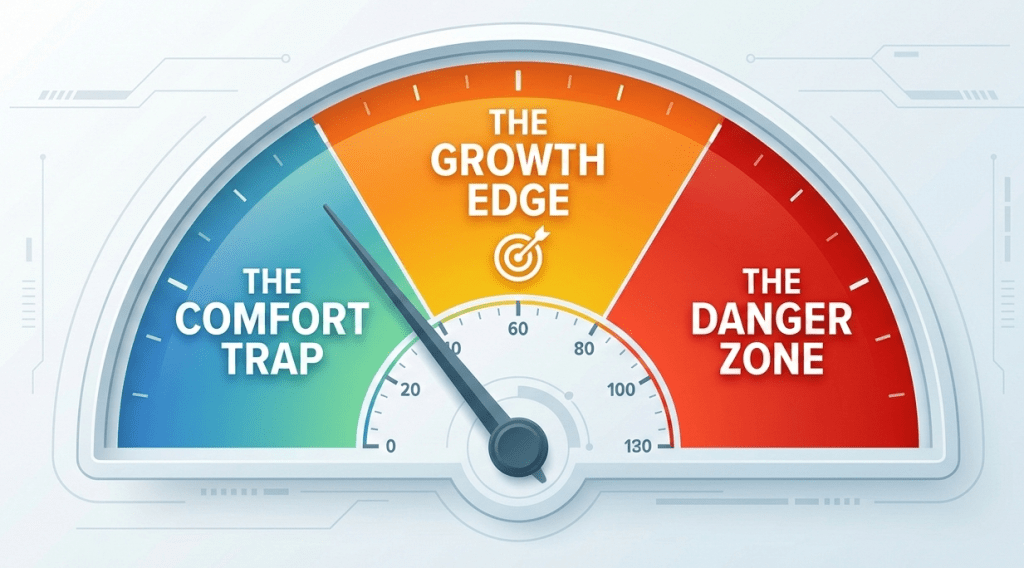
Today, Peled writes the Beyond 100% newsletter on Substack, where he describes how getting too comfortable is the enemy of progress in stroke recovery.
“Recovery lives at the edge, in the narrow space between comfort, challenge, and catastrophe. Push too hard, you risk everything (the ‘Don’t Get Injured’ Rule). Stay too comfortable, you gain nothing (the ‘Variety” Rule.),’ Peled writes. “Getting too comfortable boosts the ego but stops progress. That’s the easiest trap to fall into. It feels good to be good. But that’s exactly where growth goes to die.”
Never Stop Experimenting After Stroke
As Peled writes in his article, variety in therapy is critically important to improving our well-being after a stroke.
When it comes to the physical side of recovery, working through unique and different exercises is essential. However, if a particular exercise doesn’t feel like it’s contributing to your recovery after stroke, don’t be afraid to move on and try something new to add some variety into your routine.
In his book Stronger After Stroke, Peter Levine describes how you’ll know relatively quickly when a therapy option can be effective.
“If a therapy loses its effectiveness or does not work in a relatively short amount of time, then pitch it. Worthwhile therapies tend to show pretty immediate results,” Levine writes
I’ve experienced this in my recovery with exercises such as slacklining and walking backward. Both of these exercises felt noticeably beneficial for me early on in recovery, so I’ve kept going back to them over the years.
Get Comfortable Being Uncomfortable
Unfortunately, some deficits from stroke never go away or don’t improve to a level of your liking. Whether it be at home or out in public, stroke survivors can often feel uncomfortable physically or mentally.
Despite these frustrating situations, it’s important not to purposely avoid some uncomfortable or challenging scenarios, including trying new activities.
Just as cross-training different muscle groups can make us physically stronger, exposing ourselves to new or unique challenges can also help build our confidence after stroke.
Even if your efforts seem to fail when you’ve tried to challenge yourself, that setback can turn out to be a positive.
In his book Change your Brain, Change Your Life, Daniel Amen describes how our failures can sometimes be our best teachers.
“New brain-imaging research suggests that when some people fail their motivation centers become more active, making it more likely they will be able to learn from their experience,” Amen writes.
Rising to the Challenges of Stroke Recovery
Stroke survivors are reminded of their deficits every day.
Even if others can’t see the physical deficits or recognize the mental challenges, stroke survivors have a constant reminder of how their life has changed after stroke.
Most days can feel like nothing is easy. Everything seems to be just a bit more difficult than it used to be.
Despite those limitations, embracing the challenges of stroke recovery and constantly seeking solutions or new therapy options to support your recovery is essential.
Peled describes it perfectly in his article:
“Recovery isn’t about finding your sweet spot and staying there. It’s about constantly moving that sweet spot to places that scare you a little. Because that’s where the magic happens. That’s where you rebuild not just what you lost, but discover what you never knew you had,” he writes.
Strategies that Helped Nir After Stroke
Between relearning how to walk and rediscovering his voice after his stroke, Nir says he realized true healing required more. He’ll soon be releasing a book, Beyond 100%, where he shares what he learned.
When I reached out to Nir to discuss writing this article, he offered four strategies that have helped him to break free from the elephant trap and avoid learned helplessness after stroke.
Here’s what he suggests:
1. Start with “What if I could”: Before my stroke, I never questioned my abilities. After, I questioned everything. Now I try to flip the script: instead of “I can’t do this,” I ask “What if I could? What would I try first?”
2. Make Discomfort the Goal, Not the Obstacle: When something feels uncomfortable, I’ve learned that’s usually the sign I’m in the right place. Comfort feels good, but it’s where progress stalls.
3. Collect Your Small Wins: Every time I did something I thought I couldn’t, I wrote it down. On bad days when the elephant voice gets loud, I read that list. Evidence beats belief.
4. Don’t Get Injured: The fastest way to move backward is trying to move forward too fast. Challenge your limits, yes, but respect them too.
After a stroke, it’s easy to say no to new activities or challenging situations. But as Nir describes, while that may feel good in the moment, the comfort trap of learned helplessness is often where progress in recovery slows down.
 Stroke Recovery Rehab