By Blair Ames and David Dansereau
Balance issues are one of the most common challenges in recovery after stroke.
Due to weakness and a lack of sensation on the stroke-affected side, stroke survivors are especially at risk for falls.
Like most stroke survivors, I was slapped with the bright yellow “fall risk” bracelet in rehab since I used a walker to get around.
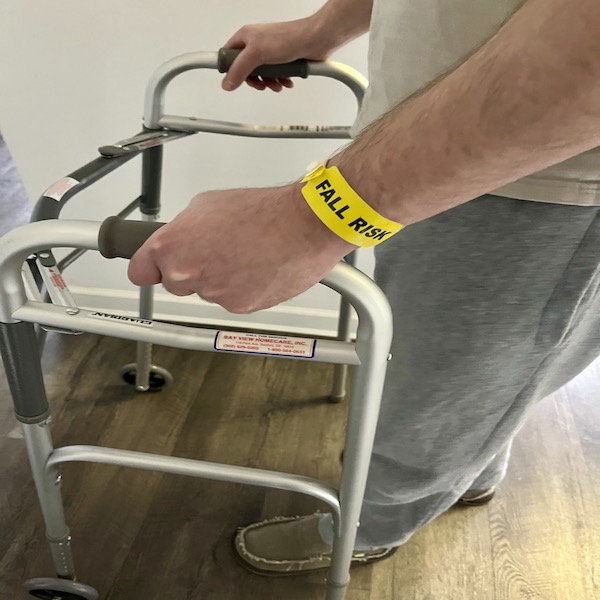
Once I returned home and sought a return to normalcy, I often lacked confidence in my balance and felt unsteady out in public.
Simple things like walking in crowds or having a conversation while standing had me looking for the nearest handrail or other support so I could steady myself if needed.
Yet, after four years of experimenting with various balance training exercises, one of the most effective also turned out to be the most simple – the single-leg stand.
Best Balance Exercises After Stroke
The single-leg stand is a foundational movement in physical therapy for stroke survivors.
A critical complement to any strength-building routine, single-leg stands are vital for learning how to walk again since walking is essentially an endless series of single-leg stands. When we’re walking, only one foot is on the ground while the other leg swings forward.
Strength coach Dan Fichter summarizes the relationship between balance and gait in this video (1:18 mark), questioning how someone can feel comfortable walking or running if their brain doesn’t feel safe standing on one leg.
There are endless variations of single-leg stands to experiment with and improve your balance. To this day, I still come across new variations of this simple exercise that I’ve found to be valuable and challenging.
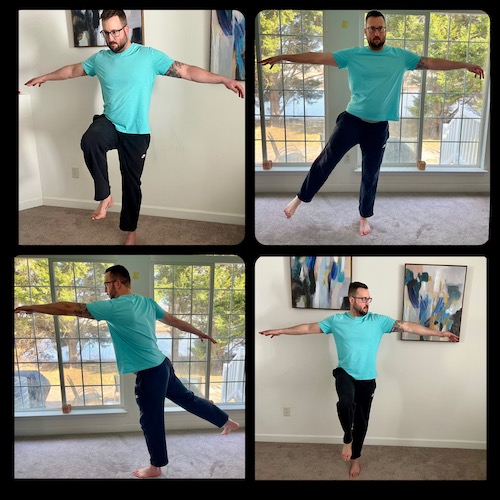
For example, there’s the standard single-leg stand where you stand on one leg with your other leg parallel to the floor (top left).
You can also stand with one leg out to the side (top right). Or you can lean forward with an arm extended in front and your other arm and leg stretched behind you (bottom left).
Lastly, if you turn your head on any of these variations (bottom right), you’ll automatically increase the difficulty since vision is so important for maintaining balance.
This is just a sampling of some straightforward single-leg balance exercises. There are many other variations and progressions that can all be done at home to challenge and improve your balance.
In his book “Balance: In Search of the Lost Sense,” Scott McCredie outlines a balance training routine that I’ve enjoyed. It contains a variety of single-leg stands, some of which are pictured above.
Balance Training After Stroke
David Danseraeu is a physical therapist, stroke survivor and host of the Know Stroke Podcast. He had a stroke in 2006 caused by a PFO (Patent foramen ovale).
I asked David about his experience in training balance after stroke and to provide insights on common balance issues that he sees as a physical therapist.
He shared the following about his challenges in improving balance after stroke:
“I was initially embarrassed by my poor balance after stroke. I needed to use an assistive device but quickly ditched it in favor of using one of my kids’ strollers to hide my needed support while restoring walking in the community.
At the time of my stroke, I had 3 kids under 7, so it became essential to use everyday tools I found around home to keep life as normal as possible for my family while I recovered my strength and balance.
Incorporating play while hacking my home stroke recovery was critical. One of my secret weapons to restore balance was incorporating fun balance challenges and using my kids’ WiiFit game as well as their swingset to challenge my balance for hours on end while playing interactive games and pushing and swinging with them.”
Dansereau will soon be releasing a book about his home stroke recovery journey, including his game plan and the tools he used to improve his balance. Visit his website to learn more about the forthcoming book.
How to Improve Balance After Stroke
A stroke can impact one or more of the body’s three sensory systems that influence balance. This includes:
1) Visual: Position of the head in relation to the environment
2) Vestibular: Orientation of the head and speed of movement
3) Somatosensory: Relative position of body parts through joint position or proprioception
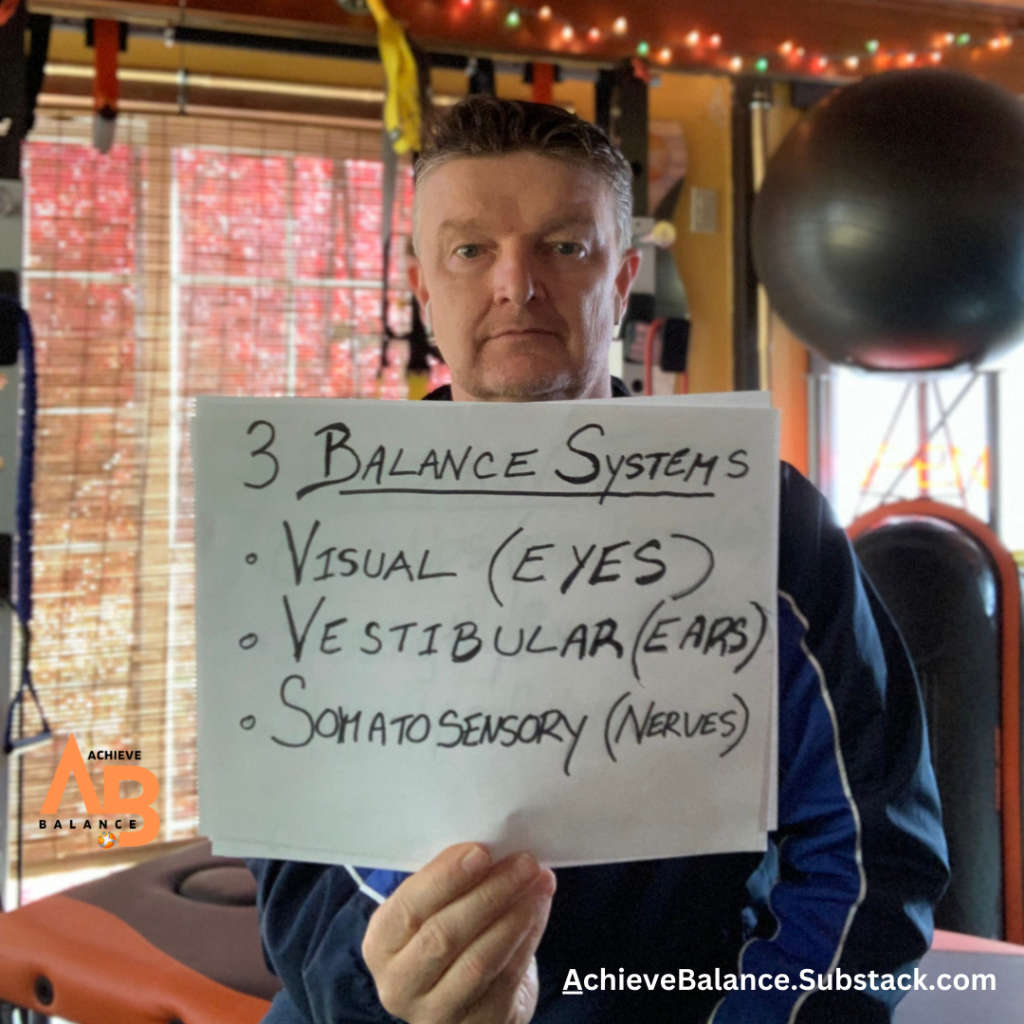
When it comes to improving balance after stroke, Dansereau says it’s important for stroke survivors to first understand their fall risk by assessing their current balance level. Then, they should invest in their success with a targeted balance plan based on their individual deficits.
Dansereau suggests four tips to build a targeted balance plan once you’ve identified which areas of balance control were impacted by your stroke:
1) Measure Progress: You can’t manage what you aren’t measuring. Record where you are starting from using a balance assessment.
For example, record how long you can stand on one leg or in different positions like Dansereau uses in the 4-Stage Balance Test. These benchmarks will help reveal your weaknesses, but they can also help motivate you.
2) Make balance training fun: Incorporate play and video games like Wii-Fit or other ExerGames that engage your body and mind in immersive environments. This can train your balance and measure progress in the background.
3) Practice balance with music: Add rhythm to your workout. Research shows that music and dance may improve the ‘cross-talk’ that needs to happen with the right and left hemispheres of the brain. This new evidence points to music making balance more fluid and automatic after stroke.
Music may also boost an important protein in the brain known as brain-derived neurotrophic factor (BDNF) that helps with growth and survival of neurons.
4) Use appropriate support: It’s ok to cheat a little until you recover your confidence. When challenging a client who is having difficulty standing on one leg, Dansereau offers them the added use of one finger to balance.
This will activate the receptors in the point of that finger to tell his clients where they are in space while giving them a point of reference. These receptors can sense changes in pressure, movement, stretch, pain, touch, and more just like in the foot.
These senses are then sent back to the brain, telling us where we are in space. As balance improves, you can remove your finger from the needed assist.
For more tips on regaining balance after a stroke, Dansereau has a review of the balance assessment tools he uses in a post on his website. He also encourages readers to reach out to a physical therapist if they need a balance maintenance ‘checkup’.
Lessons Learned in Balance Training After Stroke
Stuck at home in the immediate weeks after stroke without the ability to go out on my own, I became obsessed with balance training exercises – it’s part of the reason why I learned how to slackline.
When I reached out to David for his input on this blog, I was excited to see his top two tips mirrored my experience.
Measuring progress is important in any physical pursuit but especially after stroke when our day-to-day feelings can fluctuate wildly.
Years later, I still have the notes file on my phone where I recorded how long I could stand on each leg that first year after stroke – a little over six minutes was my best.
Second, balance training can be fun, although certainly frustrating at times.
When practicing a balance exercise, you can try and hold a position for as long as you possibly can or you can break it down into smaller segments – such as five sets for 15 seconds.
It’s best to have fun with it and not be afraid to laugh a little when you reach your limits and start looking for the nearest support to brace yourself.
Lastly, one of the best aspects of balance training is that it’s not as fatiguing as other activities, such as lifting weights at the gym. You can train balance as often as you’d like because it’s unlikely you’ll find yourself feeling any ill effects the next day.
Is Equipment Necessary for Balance Training in Stroke Recovery?
Over the years, I’ve spent countless hours standing on one leg using various balance trainers such as the Bosu ball.
I would have someone toss me lacrosse balls and other items to catch while I maintained my balance for as long as I possibly could. Sometimes I even wore an eye patch over one eye to increase the difficulty.
I was initially reluctant to buy any at-home exercise equipment after stroke. At the time, I had no idea how quickly or slowly I might progress, so the last thing I wanted to do was drop hundreds of dollars on equipment that I didn’t know how much I would actually use.
However, my frugalness evaporated over the years and I purchased too many at-home balance trainers thinking they could help me in recovery after stroke.
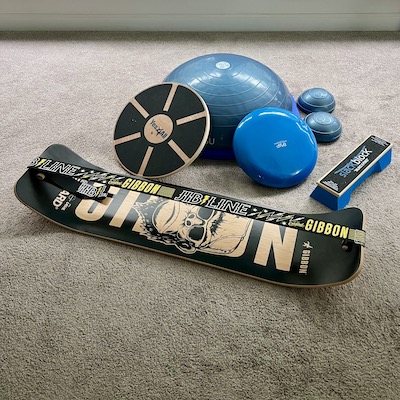
While I enjoyed experimenting with these gadgets and still occasionally use some of them, none of them proved to be essential in my recovery after stroke.
Instead, practicing a variety of single-leg stand variations like those pictured above and other balance exercises, such as slacklining, proved more valuable than spending time on in-home balance trainers.
 Stroke Recovery Rehab