Listen to this article
By Blair Ames and Florence Acosta
Stroke survivor resources often highlight the Kubler-Ross five stages of grief as part of the emotional aspect of recovery after stroke.
Created by psychiatrist Elisabeth Kubler-Ross, the model describes the five stages of grief people may experience as they cope with a significant loss. This includes denial, anger, bargaining, depression, and acceptance.
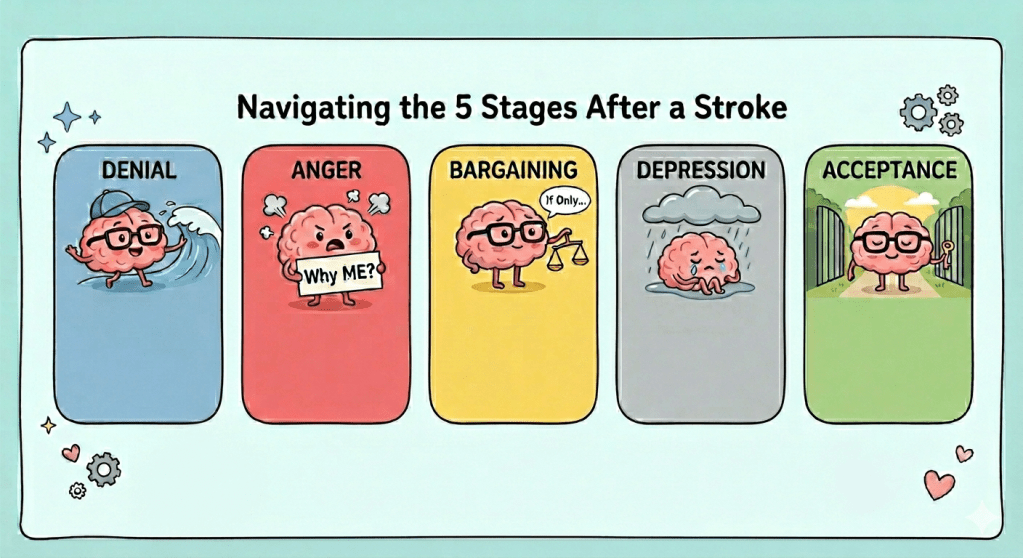
Stroke survivors can typically identify with at least one of these feelings, if not all of them. However, they won’t always experience the five stages in order and may jump back and forth between them as time passes.
Life is Divided into Before and After
I was reminded of the five stages of grief after reading a Substack post from Florence Acosta, which detailed her experiences with a hemorrhagic stroke caused by an AVM rupture.
Florence described how she existed, but felt she wasn’t living after stroke. Instead, she was just going through the motions without connection to herself.
“At 50 years old, my life didn’t just change. It was divided into before and after,” she wrote.
Florence explained that naming what she was feeling was helpful. In this case, it was grief.
“Grief doesn’t follow rules. It doesn’t move on command. It comes and goes, asking to be felt, “ she wrote.
After reading this article, I traded messages with Florence and she told me more about the impact of feeling grief after stroke.
“Even with progress, there can be a mourning for who you were before. Naming that grief (without framing it as weakness) can be incredibly validating,” she said.
Florence’s Perspective on Life After Stroke
Florence experienced a hemorrhagic stroke in 2023 while she was waiting for a dinner reservation with her husband and close friends.
She shared the following about her experiences since that time:
“Three years ago, my life split into a before and after I never could have fully prepared for.
A stroke doesn’t just change the body. It reshapes how you move through time, trust your mind, and relate to the simple act of being alive. There were moments of fear, relearning what I thought I knew, and moments of surrender to uncertainty.
What many don’t talk about is the emotional weight that can follow. Research indicates stroke survivors face significantly higher risks for depression and suicide, and those numbers reflect something real: the invisible aftermath, loneliness, and need for emotional as well as physical support after stroke.
Still, something powerful grew underneath it all: gratitude. For breath. For recovery. For those who showed up. For the parts of myself that refused to disappear.
Healing has not been linear. It has been layered with frustrations and miracles. I’ve learned strength can be soft, steady, and deeply persistent.
Recently, hearing the AVM is gone feels like another threshold crossed. It’s not an ending but a continuation of becoming.”
When the Body Survives but the Mind Grieves
I agree with Florence’s description of feeling like life is divided into before and after stroke.
However, grief of one’s former self is only one of the many challenging emotions that stroke survivors may work through, just as the Kubler-Ross model describes.
In fact, a lot of healing after stroke isn’t visible.
You can look “fine” to others but feel completely different inside as you work through identity shifts, frustration, fear of another stroke, and more.
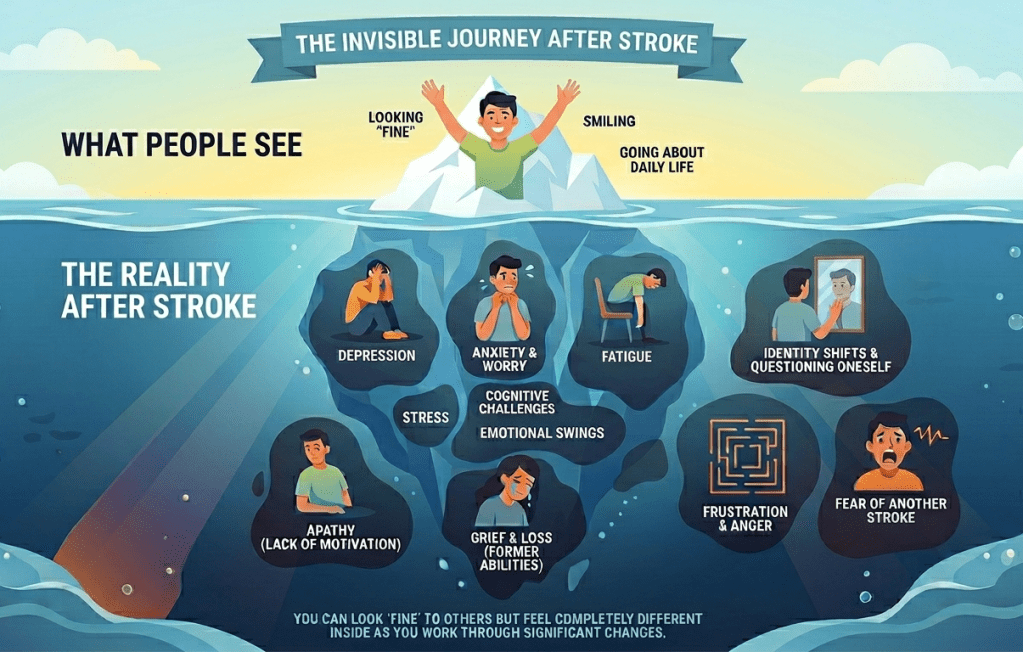
As Florence mentioned, conditions like depression, anxiety, apathy, fatigue, and emotional swings are all common after stroke.
Although these challenges may be dismissed by friends and family as “just in your head,” they’re often not. Emotional and mental challenges can be neurological changes caused by stroke.
For some, the anxiety of “what if it happens again?” can constantly live in the background and impact day-to-day life.
For others, looking in the mirror can feel unfamiliar, which only adds to the frustration and disappointment. During my stay at inpatient rehab, I remember looking in the mirror and not recognizing the person I saw looking back at me because I felt like a broken version of my former self.
Rebuilding Your Confidence
Simply rebuilding your confidence is a huge part of recovery after stroke.
Cognitive challenges, such as brain fog, memory gaps, and trouble concentrating can shake your confidence and identity, especially for people who were high-functioning or career-driven. Any changes in your mobility, speech, or appearance can also impact confidence and self-worth.
There have been many times in the years after stroke where I didn’t trust myself to do something I’ve done many times before because I initially struggled with it after stroke.
It’s taken a lot of trial and error over the years to rebuild my confidence in doing relatively simple things like cooking, driving, traveling solo, and going to a gym.
Strategies that Helped Florence in Stroke Recovery
I asked Florence if there were any particular strategies that helped her in recovery after stroke, and here’s how she responded:
“Recovery after stroke has been both physical and deeply emotional for me. The body often gets the attention first, but the mind is where much of the work happens.
I learned early that healing isn’t only about rehabilitation exercises or medical milestones. It’s also about how I speak to myself on the hardest days.
Some of the most important recovery strategies for me have been simple but consistent:
- Pacing myself instead of pushing through exhaustion,
- Building small daily routines that create stability, and
- Staying connected even when I didn’t feel like it.
Isolation after stroke can become heavy. Reaching out, whether to friends, support groups, or professionals, has been essential.
Mental health awareness matters deeply in stroke recovery. I’ve learned that asking for help is not a setback in recovery. It is critical.”
Becoming Someone New After Stroke
In trading messages with Florence, she brought up a great point about how you’re not just “getting back to who you were” after stroke.
Instead, you’re becoming someone new, and that change can be scary but also meaningful.
Your work, hobbies, creativity, and spirituality— all of the things that give life meaning – might shift after stroke, but rediscovering those passions and identifying new ones is a part of healing, even if you might be grieving your former self.

